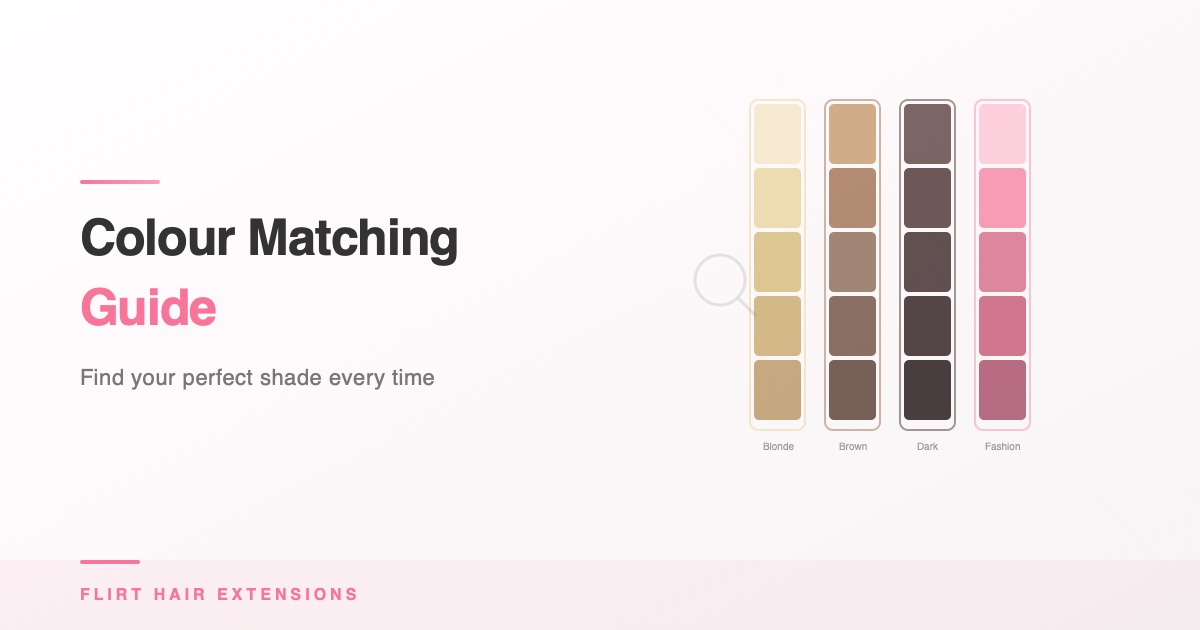
Why Colour Matching Is the Most Critical Step
You can have the most premium hair extensions in the world, installed by the most skilled stylist, and they will still look wrong if the colour does not match your natural hair. Colour matching is the single factor that determines whether your extensions look like they grew from your own scalp — or whether they look like an obvious addition.
At Flirt Hair Extensions in Pretoria, we dedicate significant time during every consultation to colour matching. It is not as simple as holding up a swatch and picking the closest shade. Your hair has depth, dimension, undertones, highlights, and variations from roots to ends that all need to be considered.
The good news? With the right approach, achieving a perfect colour match is entirely achievable — even for complex, multi-tonal hair. This guide explains exactly how professional colour matching works and what to know before your consultation.
Understanding Hair Colour Beyond the Surface
Most women describe their hair colour in simple terms — "brown," "blonde," "dark blonde." But hair colour is far more complex than a single word, and understanding this complexity is key to successful extension matching.
Base colour vs undertone:
Your base colour is the overall depth you see — light, medium, dark. Your undertone is the underlying warmth or coolness. Two women can both have "medium brown" hair, but one has warm golden undertones while the other has cool ashy undertones. Matching the base but missing the undertone is one of the most common colour-matching mistakes.
Root colour vs mid-length vs ends:
Unless you colour your hair frequently, your roots, mid-lengths, and ends are often different shades. Roots may be darker (natural regrowth), mid-lengths are your most consistent colour, and ends may be lighter (sun-bleached or from previous colour). Extensions need to match the mid-length area because that is where they blend with your natural hair.
Highlights and dimension:
If your hair has highlights, lowlights, balayage, or ombre, a single-colour extension will stand out as flat and one-dimensional against your multi-tonal natural hair. You may need extensions in two or three complementary shades to achieve a natural blend.
South African hair considerations:
South African women have an incredibly diverse range of hair colours and textures. The strong Gauteng sun can also shift hair colour over time — blonde hair may develop warm, golden tones while brunette hair can pick up coppery highlights. At Flirt, we carry an extensive colour range specifically curated for the South African market.
The Professional Colour Matching Process at Flirt
Here is exactly how we match extensions to your hair during a consultation:
Step 1: Assessment in natural light. Salon lighting can be deceptive — warm bulbs make hair look more golden, cool LEDs make it look ashier. We always assess colour near a window or in natural daylight to see the true shade.
Step 2: Sectioning and comparison. We hold extension hair against multiple sections of your head — the crown, the sides, the nape, and the face-framing area. Different areas of your head may be different shades, and the match needs to work across all visible sections.
Step 3: Undertone analysis. We look at whether your hair leans warm (golden, copper, honey) or cool (ash, silver, platinum). We then select extension hair with the same undertone. A warm-toned brunette with cool-toned extensions will look mismatched even if the depth is correct.
Step 4: Dimension matching. If your hair has highlights or multiple tones, we may recommend mixing two extension shades — a base colour and a highlight colour — to recreate the dimension in your natural hair. This is called a "custom blend" and creates the most natural result.
Step 5: Confirmation with styling. We hold the matched extensions alongside your hair and visualise how they will look when installed, blended, and styled. Sometimes a shade that looks perfect against loose hair appears slightly off when blended into a finished style. A small adjustment at this stage prevents a bigger issue later.
If your hair colour is between standard extension shades or has very specific undertones, we can also colour the extensions to create an exact custom match before installation.
Common Colour Matching Mistakes to Avoid
Matching to freshly coloured hair. If you have just had your hair coloured, the shade will fade over the next 2-4 weeks. Extensions matched to your day-one colour will be too dark or too vivid once your hair colour settles. We recommend colour matching 1-2 weeks after your salon colour appointment.
Matching under artificial light only. Fluorescent salon lighting and warm incandescent bulbs both distort colour perception. Always check your colour match in natural daylight. Any good salon will do this.
Choosing based on photos. Ordering extensions online based on a photo of your hair and a photo on a screen is extremely unreliable. Phone screens, monitor settings, and photography lighting all alter colour appearance. In-person matching against your actual hair is the only reliable method.
Ignoring your hair's multi-tonal nature. If your hair has any dimension — highlights, balayage, natural sun-lightening — a single flat colour will never blend seamlessly. You need at least two shades mixed together or a pre-highlighted extension set.
Matching to your desired colour rather than your current colour. Extensions should match your hair as it is right now. If you want to be a lighter blonde or a richer brunette, colour your natural hair first, wait 1-2 weeks for the colour to settle, then come in for your extension consultation. Alternatively, we can colour your extensions to match.
Not considering regrowth. If you colour your hair and have visible roots, decide which shade you want to match — the root or the coloured length. In most cases, matching the mid-lengths is best because the extensions sit alongside that section of your hair.
What to Do If Your Colour Changes After Installation
Hair colour is not static. It changes due to sun exposure, colour fading, new growth, and seasonal variation. Here is how to handle colour shifts while wearing extensions:
Your natural hair lightens in summer: This is common in Pretoria's sunny climate. If your extensions start looking darker than your sun-lightened natural hair, a toner can be applied to the extensions to lighten them slightly. Alternatively, a toning gloss on your natural hair can bring the two closer together.
You want to change your hair colour: If you decide to go darker or lighter while wearing extensions, the extensions will need to be adjusted too. Consult your stylist before any colour change — we can advise whether to colour the extensions, replace them with a different shade, or adjust the approach.
Colour fading between appointments: Use colour-safe, sulphate-free shampoo to minimise colour fade in both your natural hair and extensions. Purple shampoo once a week helps blonde extensions maintain their tone and prevents brassiness.
At Flirt Hair Extensions, colour management is an ongoing part of our service. If your colour shifts between maintenance appointments, contact us and we will advise the best approach — whether that is a quick toner application, an extension colour service, or simply waiting until your next scheduled maintenance.